

Data visualisation
Power, Representation and Exclusion: a Collaborative Art-Science Installation at the University of Porto
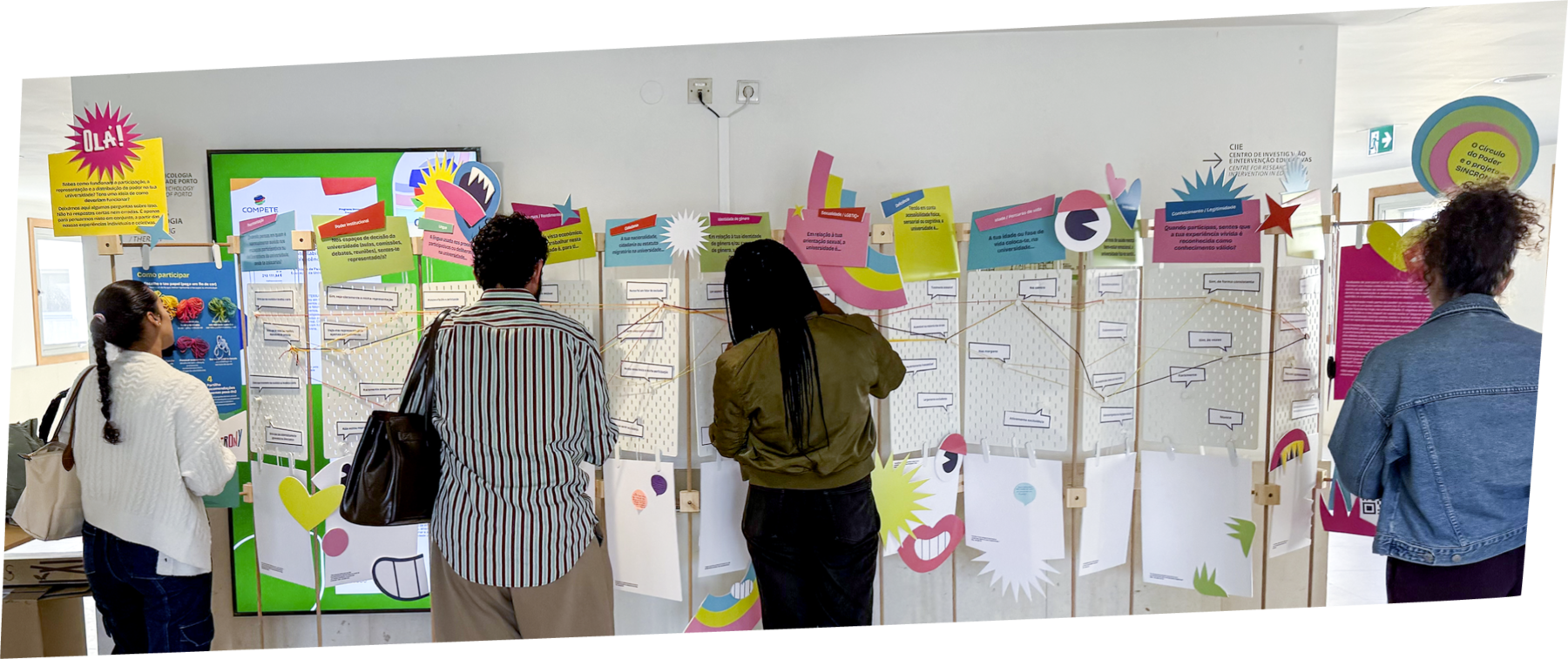
The installation, titled
This installation was produced by WeDo | Project intelligence made easy, S.L. (WeDo) and developed within the EU-funded project SINCRONY
Conceptualised by Paola Buedo (Technical University of Munich) and Mario Magaña (WeDo), Contributions and collaboration: Ángel Honrado, Mireia Manent, María Pia Aristimuño, Jorge Gutiérrez, Carlos Oliva (WeDo), Sofia Marques da Silva, Filipe Piedade (University of Porto), and Gundula Ludwig (University of Innsbruck)
As each person contributed, the threads crossed, overlapped and accumulated, gradually transforming the space into a collective visual map of university experiences, perceptions and recommendations.
Participants were also invited to leave recommendations or reflections using coloured post-its. This allowed the installation not only to collect responses, but also to open a space for imagining how the university could become more inclusive, participatory and responsive to the needs of its community.
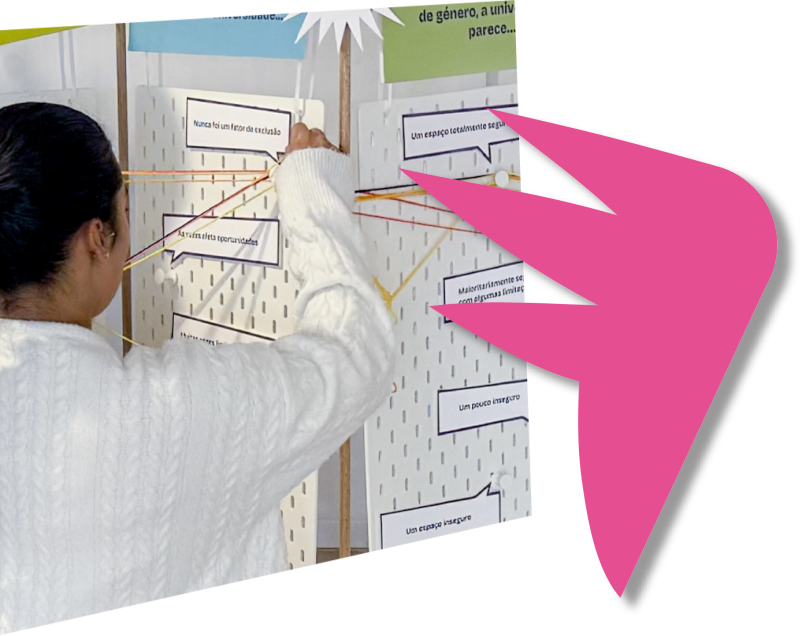
It also created a space for recommendations, inviting participants to imagine how university life could become more inclusive, participatory and responsive.university as an institution.




Do you know how participation, representation
and power distribution work at your university?
Do you have an idea on how they should work?






You have just navigated the Circle of Power. The threads you placed form a collective map of participation: a visual trace of how people feel heard, represented, or excluded within the institution. Lived experience becomes opinion, and opinion becomes data.
If you ended up closer to power or nearer the margins, this is not a judgement of who you are. It is a snapshot of how power currently works in the university. The aim is to reflect on your position and role: sometimes you are holding the door for others, sometimes you are trying to get in. And sometimes, without noticing, you help keep the door where it is.
This co-created installation draws on research from the SINCRONY project, which explores how intersectional conditions shape participation in democratic and deliberative spaces. One key insight is simple but uncomfortable: many participatory settings are built around an “ideal participant”, and those outside the norm must adapt, compensate, or step back.
As you leave, carry these questions into future participation, in the university or elsewhere: Who is at the centre? Whose knowledge counts? Who is missing, and why? What can I do, from where I stand, to shift the circle?
“Não se trata de fazer arte; trata-se de estar naquele estado maravilhoso que torna a arte inevitável.”
Robert Henri
Representation
Being heard depends on where you stand
Reflexion:
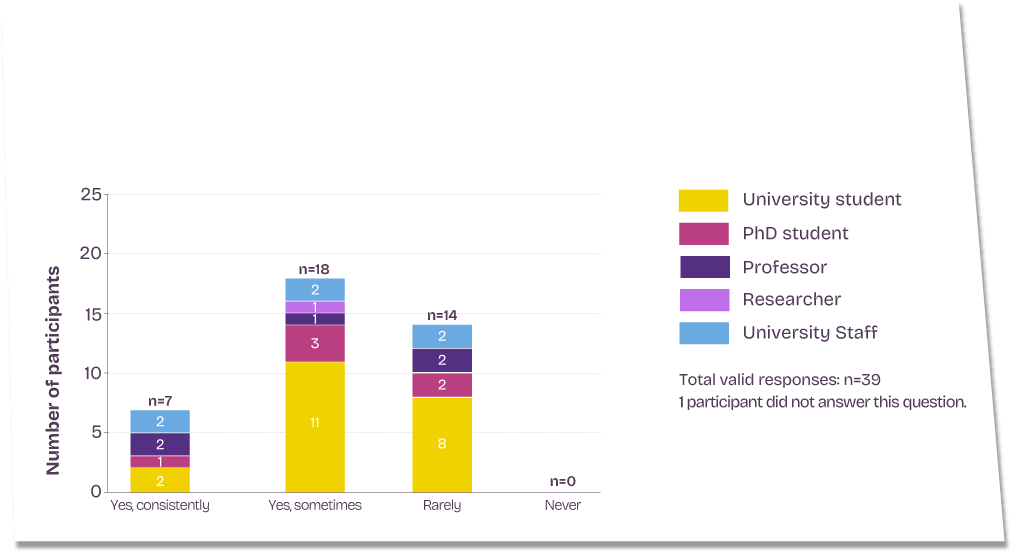
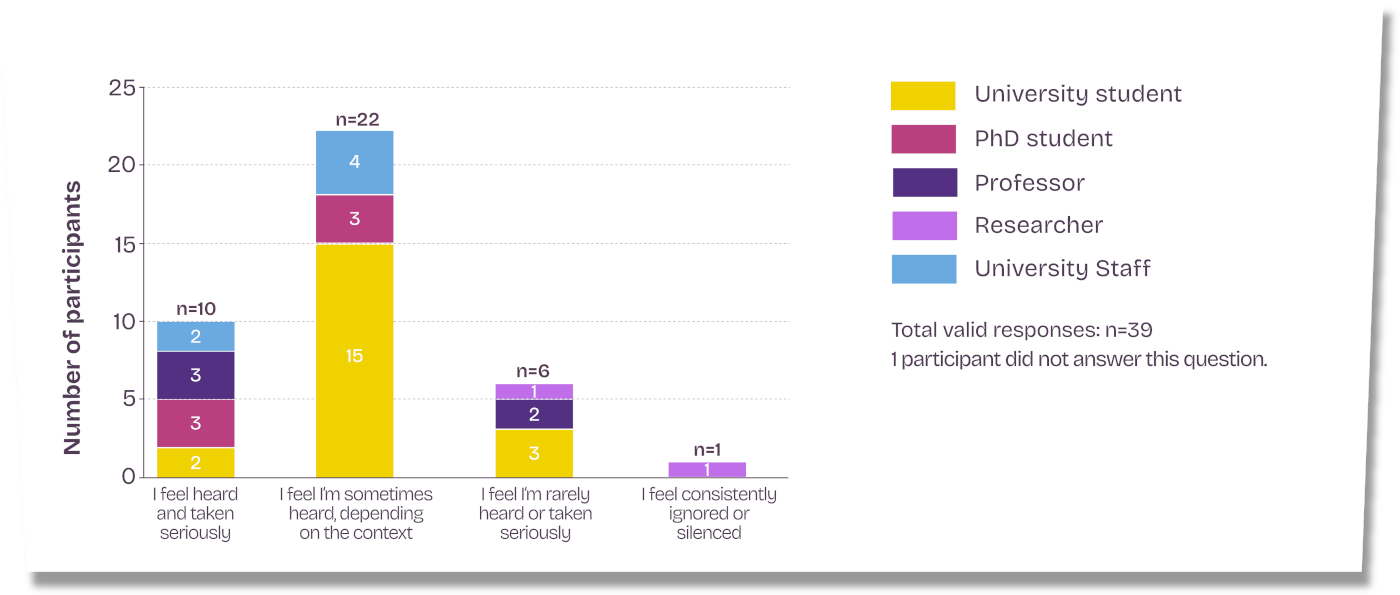
According to participants, being heard within university participative and deliberative spaces is rarely experienced as a simple yes or no. Most respondents placed themselves in an in-between position: they feel heard sometimes, depending on the context. This suggests that participation is not only about being present in a room, but about whether one’s voice is taken seriously once there.
This pattern is especially visible among university students, who mostly describe their recognition as conditional. Their voices may enter the conversation, but not always with the same weight or legitimacy. The results point to a subtle form of inequality: in the university, being allowed to speak does not necessarily mean being fully heard.
“Power structures shape who is heard and whose experiences are recognised in deliberative spaces.” (D2.1, Executive Summary)
Institutional Power
Represented, but only partially
Reflexion:
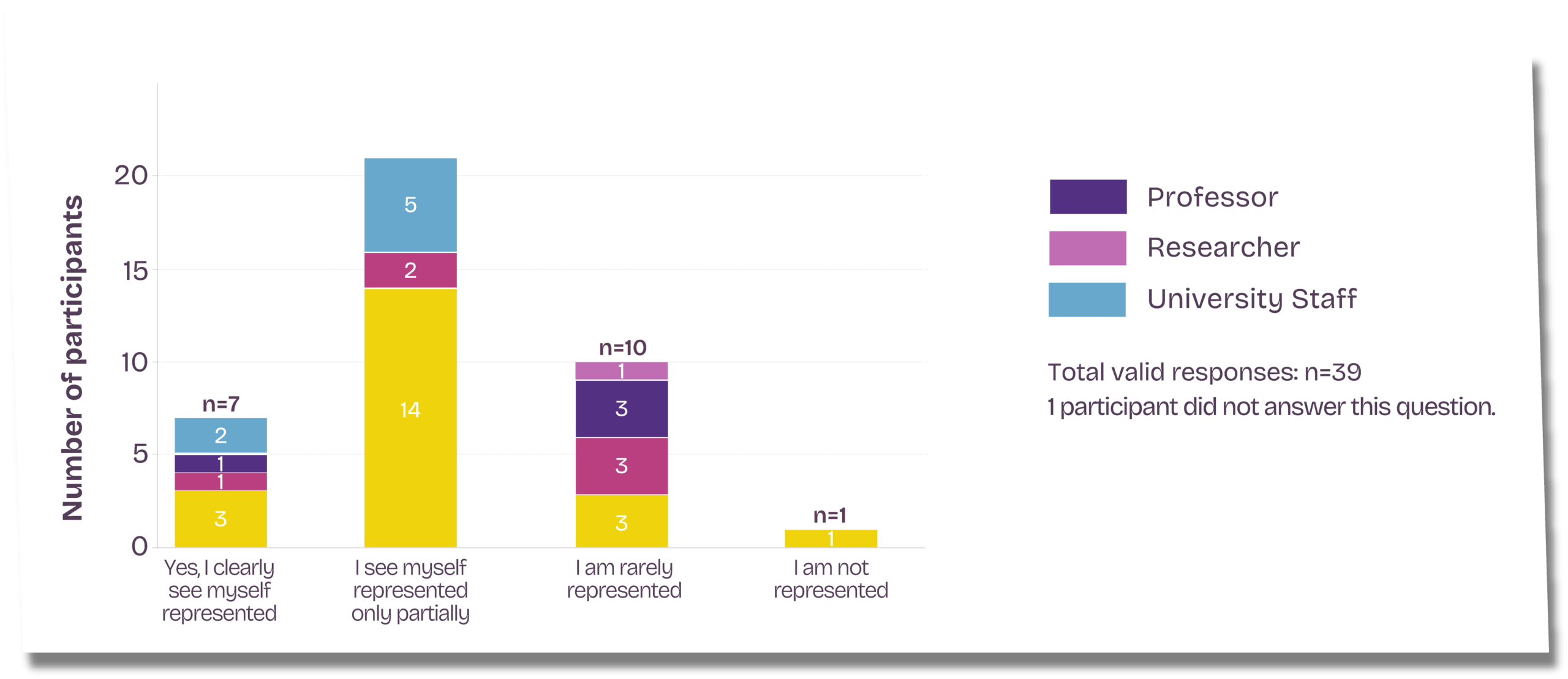
Most participants do not describe themselves as fully excluded from university decision-making spaces, but neither do they feel clearly represented. The dominant answer — “I see myself represented only partially” — suggests an intermediate and complex experience: representation exists, but it may be limited, uneven or dependent on the type of space where decisions are made.
But what does “partially represented” actually mean? It may mean being consulted but not having influence, being present but not fully listened to, or seeing some aspects of one’s experience reflected while others remain invisible. This response is especially concentrated among university students, but it also appears among PhD students and university staff. This points to a broader issue: institutional representation is not only about having formal structures for participation, but about whether those structures are perceived as capable of reflecting the diversity of people who study, work and research at the university.
“Deliberative spaces are often structured around an idealised
subject, which produces exclusion.” (D2.1, Section 2.2)
Lenguage
The lenguage you usually use at the university…
Reflexion:
Language can open doors… or close them
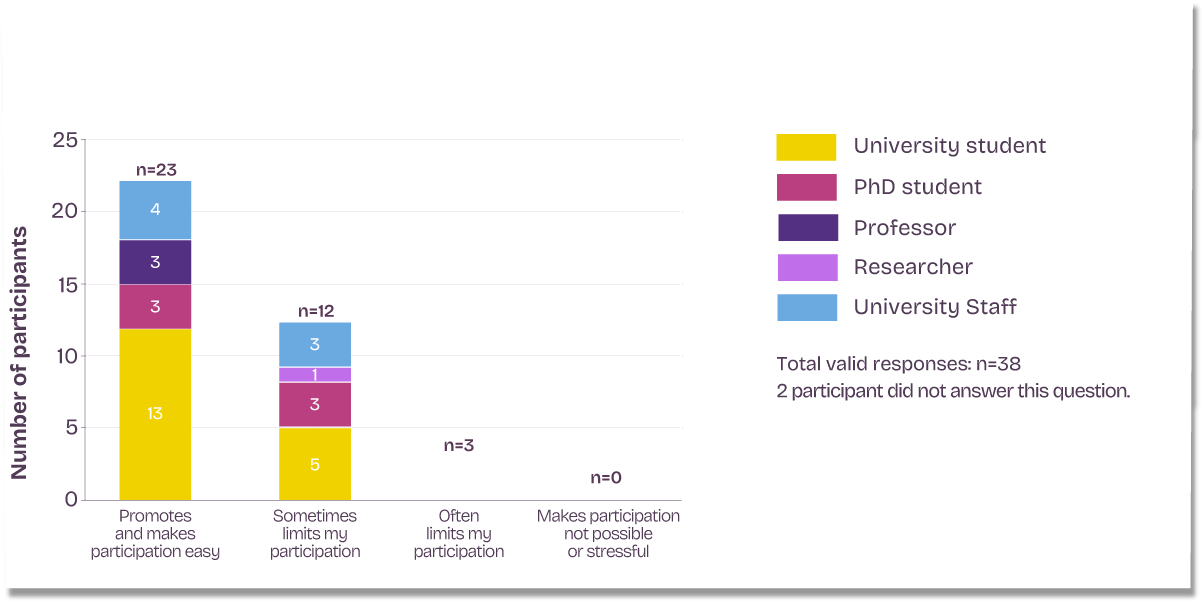
Language is mostly perceived as a facilitator of participation: 23 out of 38 valid responses say that the language used in participative or deliberative processes “promotes and makes participation easy.” This is a positive signal, suggesting that many participants feel able to understand, follow and engage with university discussions.
But the picture is not entirely smooth. 12 participants said that language “sometimes limits my participation”, and 3 participants said it “often limits my participation.” So the question is not only whether language is available, but whether it is accessible, inclusive and comfortable enough for different people to use their voice. In a university context, language can quietly shape who feels confident to speak, who stays silent, and whose contribution is recognised as legitimate whether from exchange students to even local users who doesn’t feel comfortable with the language that it’s been used.
“Language can act as a structural barrier in
participatory processes.” (D2.1, Section 2.3.2)
Wealth
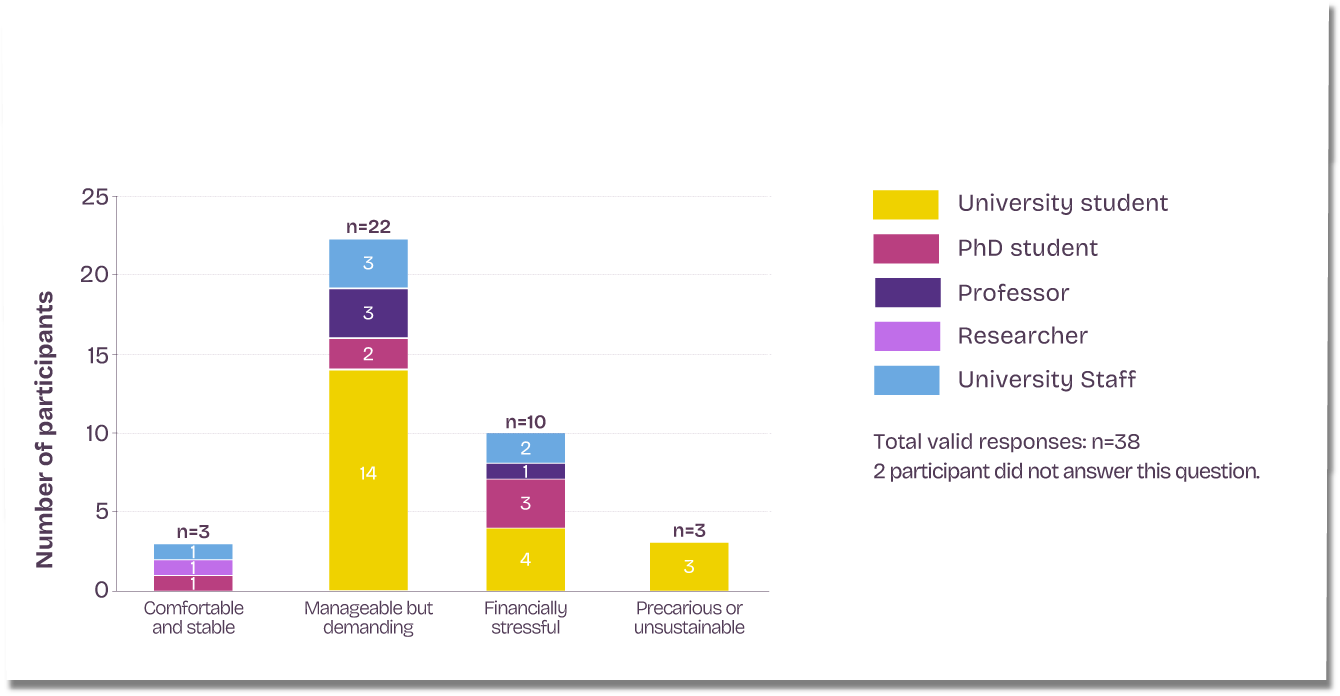
From an economic point of view, studying
or working at this university if for you
Reflexion:
Participation has a material cost
Most participants describe studying or working at the university as manageable but demanding from an economic point of view. This suggests that, for many people, university life is possible – but not effortless. Participation is not only shaped by motivation, interest or institutional access, but also by the material conditions that allow people to remain present.
The responses also show that economic pressure is not marginal: several participants describe their situation as financially stressful, and some as precarious or unsustainable. This matters because financial strain can limit time, energy, confidence and availability. In other words, participation does not happen in a vacuum: it depends on whether people have the resources to take part.
“Material resources are key elements for enabling participation.” (D2.1, Section 3)
Citizenship
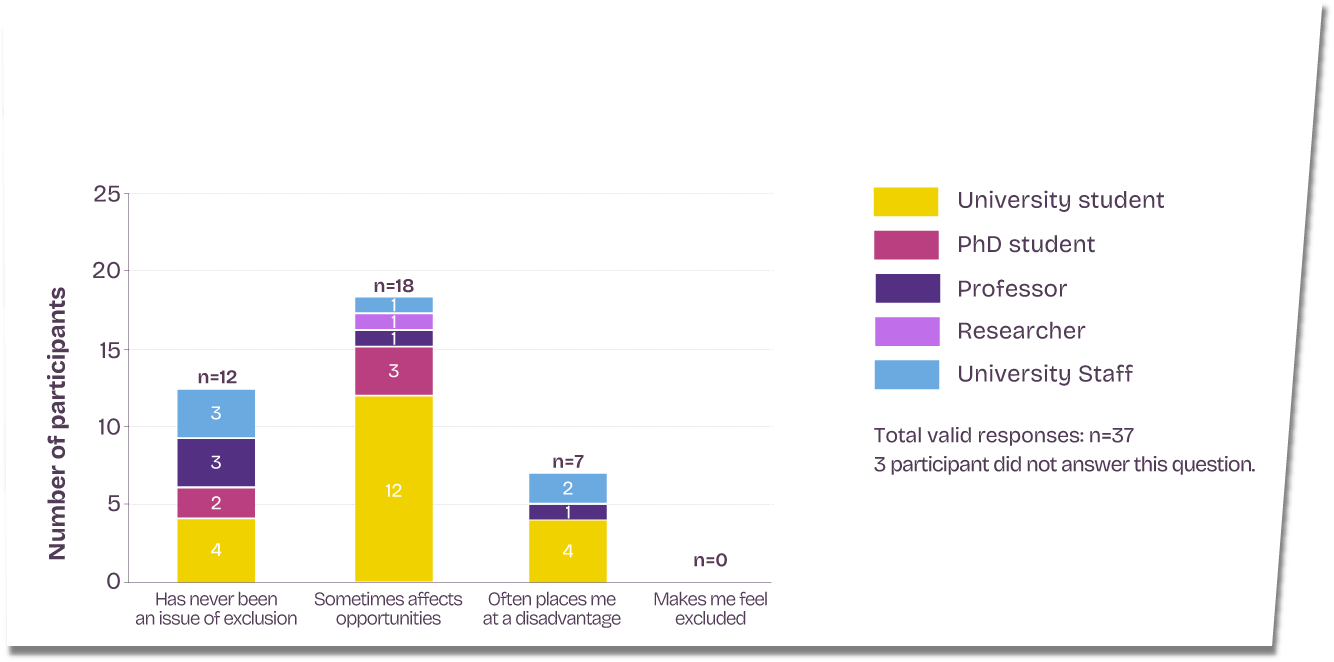
Your nationality, citizenship or migration
status at the university…
Reflexion:
Beloging is not equally secure
For many participants, nationality, citizenship or migration status is not experienced as a constant source of exclusion. However, the most frequent response indicates that it sometimes affects opportunities. This suggests that citizenship and migration status may not always operate as visible barriers, but they can still shape access, confidence and future possibilities within the university.
The results point to a form of belonging that is conditional rather than guaranteed. Some people may feel generally included, while still encountering moments where their status affects how they move through the institution. This raises an important question: who can fully imagine themselves as part of the university, and who has to negotiate their place within it?
“Citizenship and migration status structure inclusion
and exclusion in democratic spaces.” (D2.1, Section 2.2)
Gender Identity
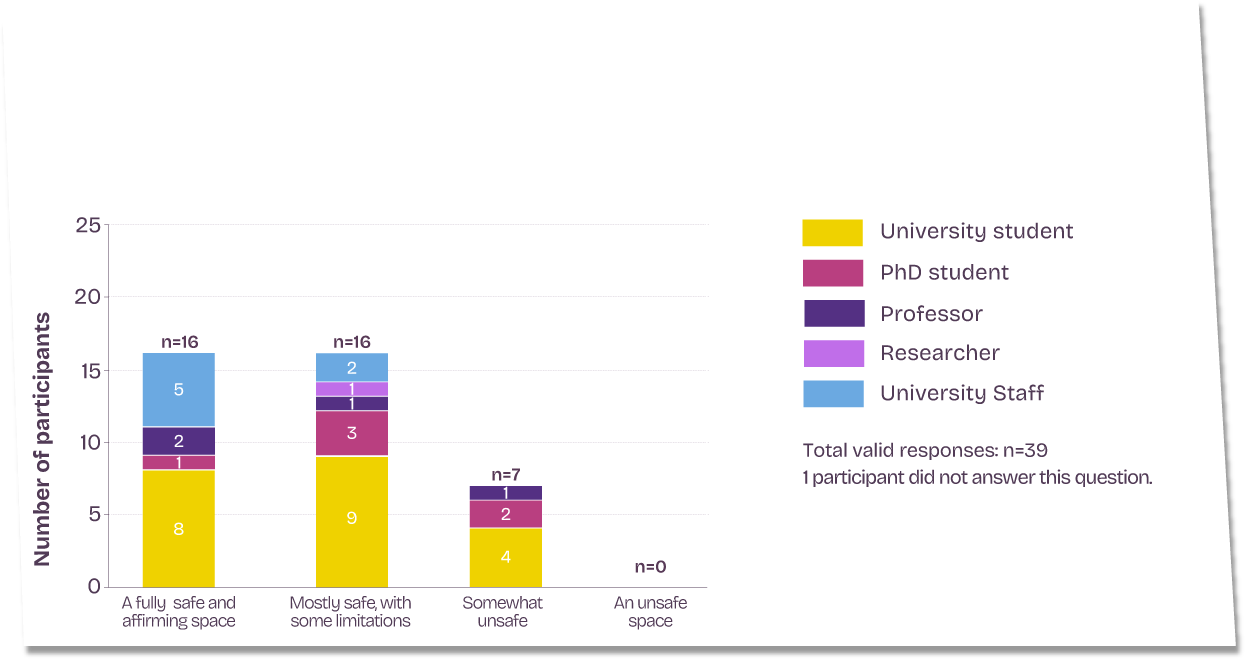
Regarding your gender identity and/or gender
expression, the university feels like…
Reflexion:
Mostly safe does not mean fully affirming
Responses around gender identity and gender expression show a relatively positive picture, with many participants describing the university as either fully safe and affirming or mostly safe, with some limitations. This suggests that the university is not widely perceived as an openly unsafe space in this dimension.
However, the presence of “some limitations” matters. A space can be mostly safe and still require people to adapt, explain themselves, avoid certain conversations or remain cautious. The results suggest that safety should not only be understood as the absence of direct hostility, but as the presence of active recognition, affirmation and support.
“Gender is a structural axis of power, not an individual characteristic.” (D2.1, Sections 2.1–2.2)
Sexuality / LGBTIQ+
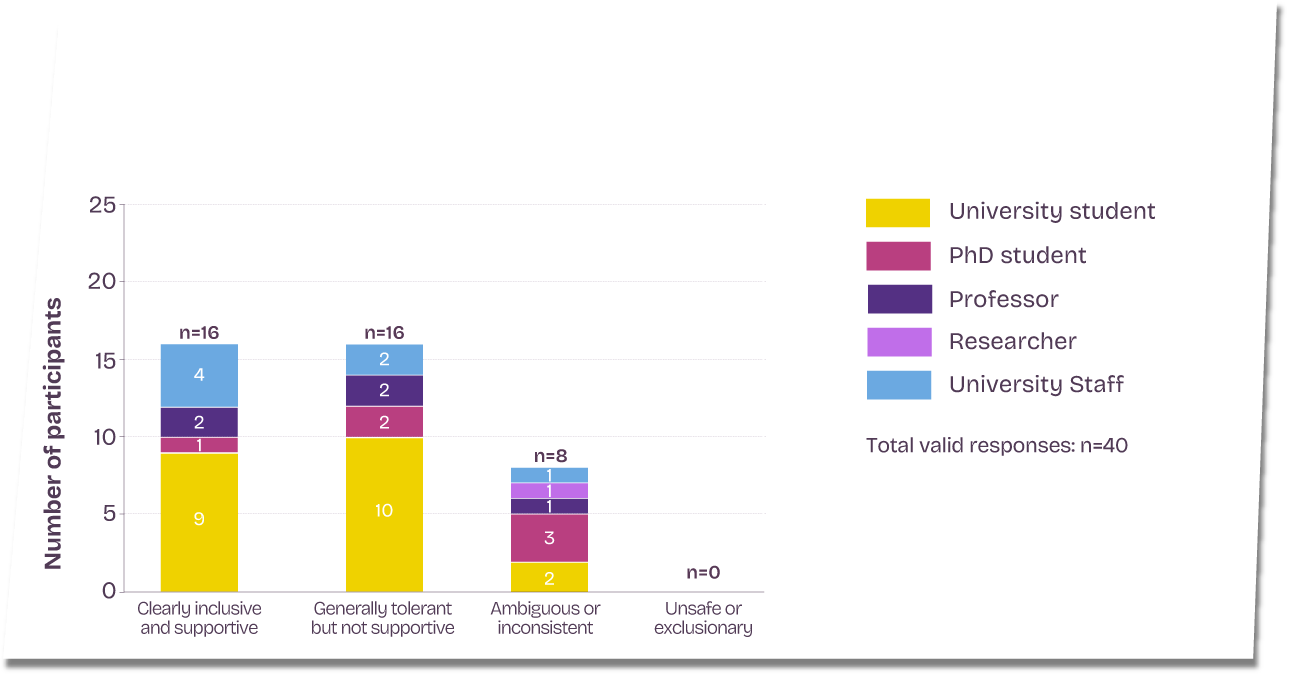
In relation to your sexual orientation,
the university is…
Reflexion:
Tolerance is not the same as support
The responses on sexual orientation are divided between those who see the university as clearly inclusive and supportive and those who describe it as generally tolerant but not supportive. This distinction is important: tolerance may mean that people are accepted, but not necessarily recognised, protected or actively included.
The absence of strong responses describing the university as unsafe is encouraging, but the data still points to a gap between passive acceptance and meaningful support. From an inclusion perspective, the question is not only whether LGBTQIA+ people can exist within the university, but whether they feel visibly valued, supported and able to participate without having to minimise part of who they are.
“Sexuality intersects with other axes of power to shape participation and belonging.” (D2.1, Section 2.2)
Disability
Considering physical, sensory or cognitive
accessibility, the university is…
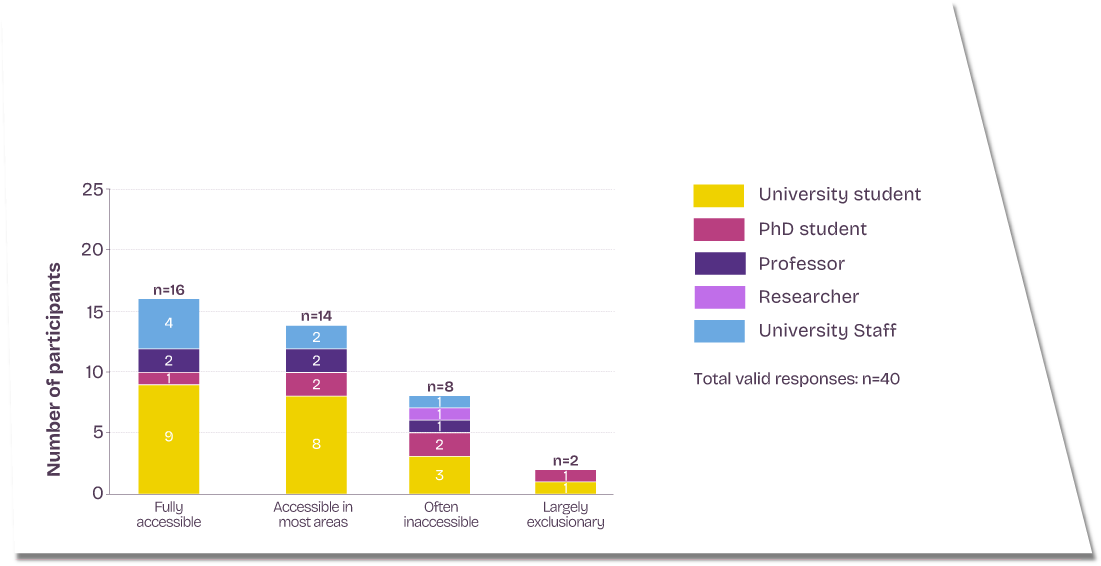
Reflexion:
Age / Life Course
Your age or life stage places you in the university…
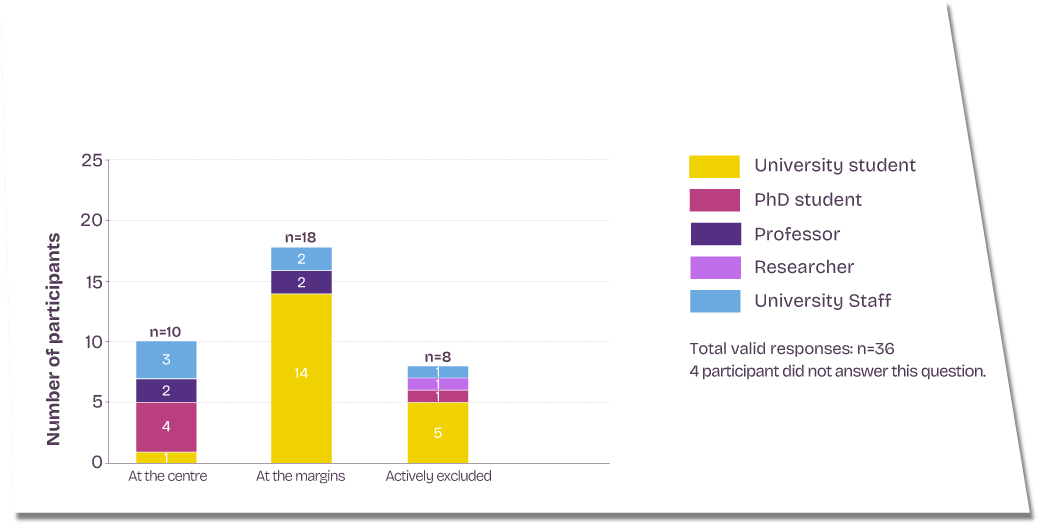
Reflexion:
Mental Health
In terms of mental health and emotional
wellbeing, the university makes you feel…
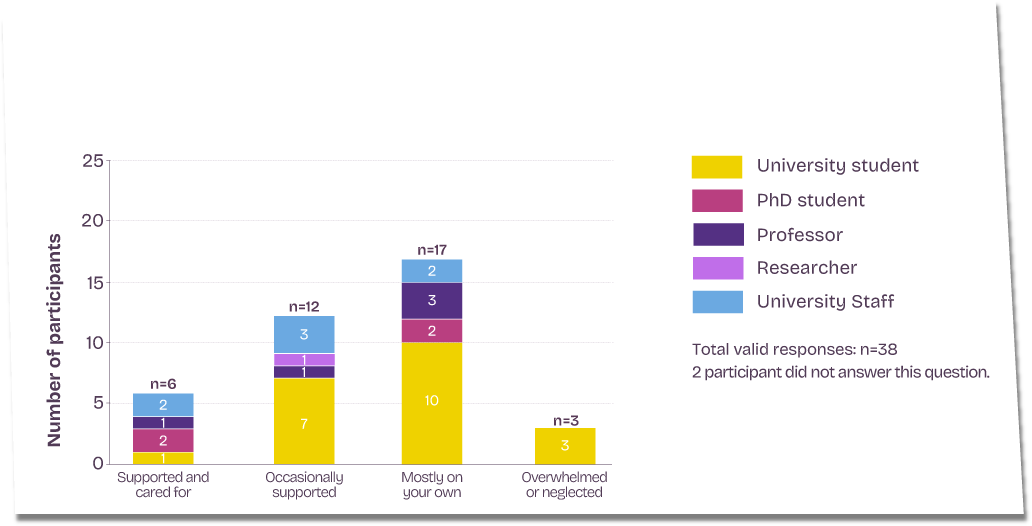
Reflexion:
Mostly on your own
Mental health and emotional wellbeing emerge as one of the more concerning dimensions. The most frequent response between students was “mostly on your own”, suggesting that many participants do not necessarily feel abandoned, but also do not feel strongly supported by the university.
This points to a gap between individual coping and institutional care. If people feel they must manage pressure, stress or emotional difficulty mostly alone, then wellbeing becomes a private responsibility rather than a shared institutional concern. The results suggest that participation and belonging are closely connected to whether people feel emotionally supported enough to stay engaged.
“Affective and experiential dimensions are central to participation and belonging.” (D2.1, Section 2.3.1)
Knowledge / Legitimacy
When you participate, do you feel your lived
experience is recognised as valid knowledge?